AI Alt Text Best Practices for Shopify
Better Context, Better Results With SEO HERO AI Alt Text Generator
-
 By
Mike
By
Mike
- Updated: August 16, 2026
- 50 min read
-
By
Mike
- Updated: August 16, 2026
- 50 min read
TL;DR
Most AI alt text tools begin with the image. SEO HERO AI Alt Text Generator can also draw on Shopify product data, brand terminology, SEO keywords, selected metafields, Google Search Console queries, custom instructions, and exclusions.
An image can show the AI what a product looks like. It cannot always tell the AI what the product actually is. For more useful results:
- Give SEO HERO reliable product facts instead of asking the model to guess.
- Use brand context to control product names, terminology, and writing rules.
- Add relevant SEO and Search Console context without forcing keywords into the description.
- Use metafields to confirm details such as material, colour, finish, or style.
- Test a focused setup on a small sample, refine it, and scale once the results are consistent.
Better inputs produce better outputs, but the goal isn't more context. It's the right context.
Why SEO HERO AI Alt Text Generator uses more than image recognition
An AI model can learn quite a bit from a product photo. It may recognize a red sneaker, red laces, a white rubber sole, and a low-top shape.
What it probably cannot determine from the pixels alone is that the sneaker is called the Nova Runner, the official colour is Crimson Red, the material is a branded vegan leather, or the product belongs to a particular collection. Shopify may already contain all of those facts.
Multiple sources can inform the generation
We call this additional context layer Hyper SEO. It is not a separate alt text generator. It is the collection of context sources SEO HERO AATG can use when it prepares a request for the AI.
The purpose is not to squeeze more information into every alt attribute. It is to give the model enough evidence to choose the right words.
The image still comes first
Extra context does not change the basic requirement: the alt text has to make sense for the image.
If a photo shows the front of a black backpack, the description should not focus on an interior laptop sleeve that no one can see unless that detail is necessary to the image's purpose. Accessibility comes first.
The W3C explains that a text alternative depends on the image's purpose, content, and context. Informative images should communicate the information they contain, while decorative images may need different treatment. W3C's image accessibility guidance is a useful reference when deciding what belongs in an alt description.
Shopify offers similar practical advice for product media. Its alt text guidance recommends brief, descriptive alt text.
If you are still building the basics, our guide to generating alt text in Shopify explains where Shopify stores alt text and how the workflow works.
SEO HERO follows the same principle. Context can make the model better informed, but image accuracy remains central.
Give SEO HERO facts instead of making it guess
Suppose SEO HERO AATG sees a photo of a green backpack. With only the image, the model might write:
That description may be accurate. Shopify, however, might contain these confirmed values:
| Shopify data | Confirmed value |
|---|---|
| Product | Velora Urban Rolltop |
| Colour | Olive Green |
| Material | Recycled Ripstop Nylon |
| Style | Urban Cycling |
| Closure | DryFold roll-top |
Now the model does not have to guess the fabric, the merchant's name for the shade, or the product name. A more informed result could be:
The model did not become more capable between those two attempts. The second request simply contained better evidence.
What the AI sees vs. what Shopify knows
SEO HERO AI Alt Text Generator can combine image analysis with Shopify product context, brand settings, SEO signals, metafields, and custom instructions.
Use Shopify product data as context
Shopify stores already hold information that can help the AI identify a product. SEO HERO can use selected catalog data such as the title, description, vendor, collections, and variants.
Selected is the important word. Supplying a field as context does not mean copying it into the final description.
Consider this product title:
Pasting it into an alt attribute would sound like a database export. As context, though, it tells the model that the image belongs to an Acme Nova running shoe.
ACME MEN'S RUNNING SHOE | RED | SUMMER 2026 | NOVA
Acme Nova red running shoe with white rubber sole.
The same judgment applies to product descriptions. A short, factual description can help the model understand the item. A 600-word description full of shipping details, promotions, cross-sells, and sales copy may contribute more noise than information. SEO HERO AATG lets merchants choose which data enters the generation process.
Use metafields to confirm attributes
Metafields are especially useful when an image cannot reliably reveal a product detail. A model might see a brown surface, but it cannot know whether the merchant calls the finish Walnut, Espresso Oak, or Dark Acacia.
A metafield can provide the exact term:
Let Shopify confirm what the image cannot
Instead of relying on a visual assumption, SEO HERO AATG can work with the merchant's confirmed material, colour, finish, and pattern terminology.
SEO HERO AATG can use selected product and variant metafields as context. For colour, pattern, material, style, and similar attributes, this gives the generation process the merchant's terminology instead of relying on a visual assumption. Stores with specialized materials, proprietary colours, multiple finishes, or detailed variants may find this particularly useful.
Selection still matters. A warehouse bin such as warehouse_bin_8812, an internal margin, a technical integration ID, or a long JSON object does not help anyone understand the image.
A simple test works well: would this field help someone understand what the product is or what appears in the image? If so, it may be useful. Otherwise, leave it out.
Teach SEO HERO the brand's vocabulary
Product data answers, "What is this?" Brand context answers, "How do we describe it?"
SEO HERO AI Alt Text Generator separates several kinds of brand context because each has a different job.
Different inputs answer different questions
Instead of treating every setting like another keyword field, SEO HERO gives each type of context a specific role.
Explains the overall business and stable store-wide context.
Provides important brand names, product lines, and proprietary terminology.
Sets consistent rules for terminology and generation behaviour.
Adds useful generic search language when it fits the product and image.
Blocks unwanted promotional, inaccurate, or off-brand terms from new generations.
Business details
Business details should give the model a short, useful description of the company. For example:
That is enough background to guide word choice. The return policy, shipping schedule, company history, warranty terms, and current promotion do not belong in this field.
Brand keywords
Brand keywords identify names that matter to the store, such as:
These are brand or product terms, not general SEO keywords.
Custom instructions
Custom instructions tell SEO HERO how to handle the output. Compare these two prompts:
Describe the product type first. Use "backpack," not "bag." Mention colour only when it is clearly visible or confirmed by product data. Do not use promotional language.
Make the alt text very SEO optimized.
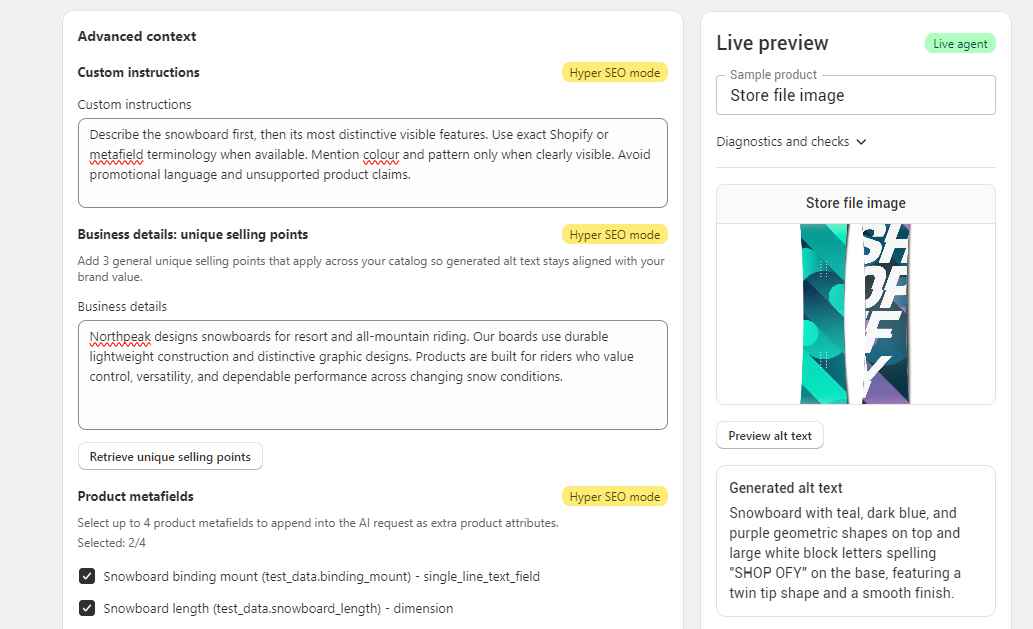
The first prompt provides rules the model can follow. The second leaves too much room for interpretation. Clear instructions make the results more predictable.
SEO HERO can use the terminology, business context, and writing rules that matter to your store instead of producing a generic image caption.
Add SEO context without stuffing keywords
SEO keywords can help the model understand a product. A list such as this does not:
Those first phrases may reflect commercial intent, but they do little to describe an image. The second group is more useful because it tells the model what kind of product people may be looking for.
Google's image SEO best practices recommend useful, information-rich alt text with keywords used appropriately and in context. Google also warns against filling alt attributes with keywords.
SEO HERO can consider relevant keywords, but those keywords should never overrule the image. If a phrase does not naturally fit the visible content or the confirmed product data, omitting it is usually the better choice.
SEO context should guide the description, not dictate it.
Use real Google Search Console queries
Manual SEO keywords tell us what terms we think matter. Google Search Console can show what people are actually searching for.
For example, a Shopify product might already receive search impressions for:
These queries reflect how that product appears in Google. SEO HERO can use product-matched Search Console queries as optional context. The app cleans and deduplicates those queries, then can send a small set of relevant terms to the AI for the matching product. If a product has no matching Search Console data, generation can continue normally.
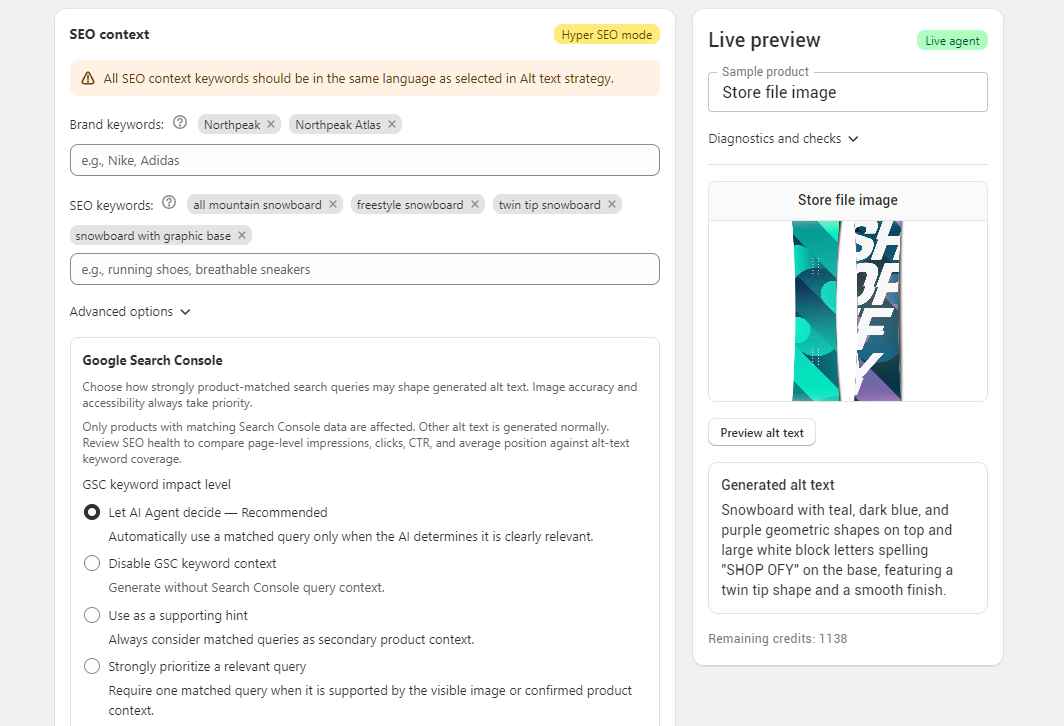
Real search data meets real product context
Search Console does not have the final say. A query can be useful for SEO and still be wrong for a particular image. The image and confirmed product facts remain the stronger signals.
Real search data is useful context, not a keyword command. SEO HERO can use a matched query when it genuinely helps describe the image and product.
Tell SEO HERO what to avoid
Improving an AI configuration is partly about removing bad options. A store may decide that product image alt text should never contain words such as:
Those terms can be excluded. Merchants can also set broader rules:
Product and search data show the model what information is available. Exclusions keep it from using that information in unwanted ways.
Useful context goes in. Unwanted language stays out.
Hyper SEO can combine positive context with clear boundaries before the final alt text is generated.
Define how product details should be described and which rules the output should follow.
Block promotional, inaccurate, repetitive, or off-brand language from new generations.
Negative inputs are part of Hyper SEO too. In some cases, telling the model what to avoid is as useful as giving it another fact.
Better AI starts before generation
Give SEO HERO the relevant product facts, brand rules, search context, and exclusions before generating a large batch. This reduces the amount of correction required afterward.
Configure → Test → Refine → Scale
More context is not always useful context
SEO HERO can accept a large amount of information. Turning on every source is rarely the best starting point.
Consider these two configurations.
Setup B is much shorter, but almost every line helps identify or describe the product. Relevant context is more useful than maximum context.
A filename is only useful when the filename is useful
Some sources can provide strong context in one store and almost no value in another.
velora-urban-rolltop-olive-front.jpg
IMG_4921-final-v2.jpg
Filenames are a good example. velora-urban-rolltop-olive-front.jpg provides a meaningful clue. IMG_4921-final-v2.jpg does not. SEO HERO lets merchants decide how to treat filename context. Ignoring filenames is the safest starting point when naming quality varies.
Two reliable metafields can be better than four unclear ones.
Five focused SEO keywords can outperform thirty broad phrases.
Three direct instructions may work better than a long prompt with overlapping rules.
Aim for signal, not volume.
How context changes the same alt text
The clearest way to understand Hyper SEO is to follow one image through several stages. Suppose each stage uses the same red sneaker photo.
Build the SEO HERO context
Turn each context layer on to see how the same product image can produce a more informed description.
Red sneaker with white sole.
Result: Red sneaker with white sole.
Possible result: Nova Runner red VeganFlex sneaker with white rubber sole.
Possible result: Acme Nova Runner red VeganFlex sneaker with white rubber sole.
Possible result: Acme Nova Runner red vegan sneaker with white rubber sole.
The final version is only slightly longer than the first. Better context does not need to produce more words. It helps the model choose better-informed words.
Better context does not have to create longer alt text. It gives SEO HERO better information for choosing the words that actually belong in the description.
Does AI alt text help SEO?
Useful alt text can support image SEO, but adding more keywords does not automatically make it better.
Google says it uses alt text together with computer vision and the surrounding page content to understand an image. Its guidance recommends useful, information-rich descriptions with keywords used appropriately and warns against keyword stuffing.
More keywords do not mean better alt text
Relevant search language can strengthen an accurate description. Unrelated or repeated keywords usually make it worse.
Red vegan sneaker with white rubber sole.
Best red sneakers cheap vegan sneakers buy sneakers red shoes sale sneakers.
SEO HERO's additional context can help the model choose more accurate language. It is not an excuse to add search terms that do not belong in the description.
The strongest SEO alt text is still useful alt text.
Test the configuration before scaling
The usual advice for AI output is to review everything because the model is not perfect. That is sensible, but it misses a useful question: why did the model produce that result?
If material information keeps disappearing, perhaps the correct metafield is missing. If one keyword appears too often, the SEO list may be too broad or Search Console may have too much influence. Repetitive descriptions can point to instructions that are too rigid. An invented attribute may come from a noisy context source or a missing guardrail.
Treat quality control as a repeatable debugging process.
Configure → Test → Refine → Scale
Instead of fixing individual descriptions one by one, use a representative sample to find patterns and improve the configuration behind them.
Diagnose the input behind the result
A practical testing process looks like this:
- Configure the basic product, brand, and search context.
- Choose about 10 to 20 images that cover different products and variants.
- Generate a first sample.
- Check for missing or invented details, repetition, and forced keywords.
- Identify the context source most likely to cause each problem.
- Change one category of settings.
- Generate another sample and compare it with the first.
- Scale the configuration once the results are consistent.
If you change keywords, metafields, tone, model, exclusions, and instructions together, you will not know which adjustment actually improved the result.
Debug the inputs as well as the output.
SEO HERO is designed to create a context setup that can produce consistent descriptions across hundreds or thousands of Shopify images.
Recommended starting setup for SEO HERO AATG
A fashion store, a furniture retailer, and an industrial parts catalog need different data, so there is no universal setup. Use this as a focused starting point:
Start focused, then add context when it helps
Begin with reliable catalog data and a small set of rules. Add more context only when testing shows a clear benefit.
The recommended setup is a starting point, not a requirement to turn on every context source. Test the output first, then add or remove context based on what actually improves the descriptions.
Why context matters more in large Shopify catalogs
Writing alt text for ten images is manageable. At 5,000, consistency becomes the harder problem. Different writers might call the same product a "green backpack," an "olive rucksack," or a "waterproof cycling bag," even when the merchant prefers one term.
A well-configured SEO HERO setup gives every generation the same rules and product context. Once tested, that setup can support bulk generation and new catalog images without turning alt text into a recurring manual project.
The real value at scale is not simply generating faster. It is creating a repeatable alt text system that stays aligned with the store.
Why we built SEO HERO AATG around context
Describing an image is the easy part. Understanding the Shopify store behind it is harder. Hyper SEO addresses that gap with these context layers:
SEO HERO can understand more than the pixels
Each context source adds a different type of evidence. Merchants can choose the layers that actually help their products instead of sending every available field to the AI.
No store needs every layer for every product. For Shopify merchants, this depth of configurable context is what makes SEO HERO fundamentally different from a basic image-to-alt-text generator.
The difference is not simply more AI. It is giving the AI access to the right Shopify, brand, and search context before generation.
Better inputs produce better outputs
An image may show a green backpack, while Shopify identifies it as a Velora Urban Rolltop. Metafields can confirm Olive Green and Recycled Ripstop Nylon, brand settings can require "backpack" instead of "bag," Search Console can supply "waterproof cycling backpack," and custom instructions can block promotional language.
SEO HERO combines those signals to choose more accurate words, not more words or keywords.
Better alt text starts with better evidence
Each source adds a different kind of context before SEO HERO generates the final description.
Start with a small sample. Test the context, refine it, and scale the setup that works.
Better inputs produce better outputs, but the goal isn't more context. It's the right context.
Final takeaway
Better image recognition solves only part of the problem. SEO HERO can also consider Shopify product facts, brand terminology, relevant search language, metafields, custom instructions, and exclusions.
That gives the model a stronger basis for writing the description. Instead of asking only, “What do you see?”, Hyper SEO helps the generation process ask a more useful question:
That is the key difference. Better inputs produce better outputs because the model receives the right context.
With SEO HERO AI Alt Text Generator, you can combine image analysis with Shopify product data, brand context, SEO signals, metafields, and custom instructions to create more informed alt text at scale.
FAQs
Does SEO HERO AI Alt Text Generator use more than the product image?
Yes. It can combine image analysis with Shopify product data, selected metafields, business and brand context, SEO keywords, instructions, exclusions, and matched Google Search Console queries. The image remains one of the strongest signals.
What is Hyper SEO in SEO HERO AATG?
Hyper SEO is the set of context sources SEO HERO can provide during generation. It helps the model understand the product, terminology, SEO context, and writing rules; it is not a separate generator.
Can SEO HERO use Shopify product metafields?
Yes. Selected product and variant metafields can confirm materials, commercial colour names, patterns, finishes, styles, and other details that may be difficult to identify visually.
Should I enable every metafield?
Usually not. Start with a few fields that contain clear, reliable product or image information and exclude technical or irrelevant data.
Can SEO HERO use Google Search Console queries?
Yes. Product-matched Search Console queries can provide real search language as optional context, but a query should never override the image or confirmed product data.
What is the difference between brand keywords and SEO keywords?
Brand keywords belong to the store’s identity, such as a brand name, product line, or proprietary technology. SEO keywords are broader search terms associated with the products.
| Type | Example |
|—|—|
| Brand keyword | Velora |
| Brand keyword | DryFold |
| SEO keyword | waterproof cycling backpack |
| SEO keyword | recycled fabric backpack |
Both can help, but neither should make the description inaccurate or unnatural.
Can I tell SEO HERO which words not to use?
Yes. Exclusions can block promotional wording, off-brand terms, or repetitive language found during testing.
Should SEO HERO use image filenames?
Only when they contain reliable information. `velora-rolltop-olive-front.jpg` may help; `IMG_4921-v2.jpg` does not. Ignore filenames when naming is inconsistent.
Can AI-generated alt text support accessibility and SEO together?
Yes, if the description stays accurate and useful. Accessibility should determine what the image communicates, while relevant search language can support it when it fits. Google warns against keyword stuffing, and the W3C ties the correct alternative to the image’s content and purpose.
Why does AI alt text sometimes sound generic?
It may lack useful context. A model can recognize a “black shoe” without knowing its name, material, variant, brand terminology, or relevant search language. Check the inputs before changing the model.
Should I manually review every SEO HERO generation?
For a large catalog, test a representative sample first. If it consistently follows the product facts, terminology, SEO strategy, and writing rules, scale the same configuration with more confidence.
How do I improve SEO HERO's results?
Start with the inputs. Add a reliable source for missing attributes, adjust repeated words through keywords or exclusions, provide a metafield when the model guesses, and simplify instructions when the output feels rigid. Change one type of context at a time and test again.
Is more context always better?
No. Relevant, reliable context beats volume. Five strong keywords can be better than thirty weak ones, two clean metafields can outperform four confusing fields, and a direct instruction can work better than a long, conflicting prompt.
Is SEO HERO AATG suitable for large Shopify catalogs?
Yes. Configurable context and bulk workflows create a reusable setup that keeps descriptions aligned with the store’s product data, terminology, and SEO strategy.

Hey, I’m Mike Belanger, a business enthusiast with over 15 years of experience in designing, web and app development, business management, digital marketing, customer psychology and optimizing businesses. I love making businesses grow and operate smoother.