The Crisp Support Knowledge Gap
Why 65% of Respondents Are Stuck With Repetitive Questions or Outdated FAQs
-
 By
Mike
By
Mike
- Updated: July 27, 2026
- 32 min read
-
By
Mike
- Updated: July 27, 2026
- 32 min read
The Crisp Support Knowledge Gap is the space between what customers keep asking in Crisp Live Chat and what a company’s approved support content can answer. We found that 97 of 148 responses, or 65.5%, chose either too many repetitive questions or outdated or missing FAQs as their biggest support challenge.
This tells us something important. Repetitive support is often a knowledge problem, not only a staffing or response-speed problem. We reached this finding through the Help Desk Hero onboarding survey, which included 155 survey sessions across 111 unique websites. We explain the sample, limits, and exact math below.
- 65.5% showed a knowledge-gap signal. Of 148 support-challenge responses, 67 chose repetitive questions and 30 chose outdated or missing FAQs.
- Speed is not the full answer. A saved reply can close one chat faster. It does not fix unclear pages, missing help content, or old product information.
- Support chats are customer research. Another 43 responses selected a lack of insights from customer feedback.
- We need a knowledge loop. Capture, cluster, convert, review, reuse, and measure the patterns inside Crisp conversations.
- AI comes after clean knowledge. A chatbot trained on weak or conflicting material can repeat the same problem at greater speed.
How We Collected the Data
We used aggregate data from the Help Desk Hero onboarding survey. At the time of analysis, it contained 155 survey sessions from 111 unique websites.
Of those sessions, 118 were completed, 26 were aborted, and 11 were still in progress. The dashboard reported a 76% completion rate and an average of 7.7 answers per session.
Not every person answered every question. That is why the denominator changes throughout this article:
- Business type: 155 responses
- Biggest support challenge: 148 responses
- Desired business impact: 144 responses
- “AI chatbot trained on your data”: 120 recorded responses
Who Took Part?
| Business type | Responses | Share |
|---|---|---|
| SaaS or software company | 75 | 48.4% |
| E-commerce or online retail | 43 | 27.7% |
| Other service business | 22 | 14.2% |
| Professional services, agency, or consulting | 11 | 7.1% |
| Healthcare or education | 4 | 2.6% |
SaaS and e-commerce made up 118 of the 155 business-type responses, or 76.1%. This describes the sample. It does not prove that either group had a different support challenge. We would need response-level data by segment to make that comparison.
Important limit: 155 sessions do not mean 155 companies. A website could appear in more than one session. Until the 148 support-challenge responses are deduplicated by company, we use “responses” or “respondents,” not “148 teams.”
65.5% Selected a Support Knowledge Gap Challenge
The strongest pattern was not hidden in a complex model. It came from two direct answers.
Among the 148 responses to “What’s your biggest support challenge?”, 67 selected too many repetitive questions and 30 selected outdated or missing FAQs.
selected either too many repetitive questions or outdated or missing FAQs as their biggest support challenge.
67 repetitive-question responses + 30 outdated or missing FAQ responses = 97 knowledge-gap responses.
97 ÷ 148 = 65.5%.
These answers are connected. Repeated questions often point to missing information. Old FAQs also create repeat questions because customers must ask whether the published answer still applies.
Even when an agent gives the right answer, that knowledge may remain trapped inside one conversation. The next customer asks the same question, another agent answers it again, and the cycle continues.
Repetitive Questions Are a Symptom, Not the Root Problem
Saved replies can help. They cut typing time and give agents a common answer. But they solve only the current chat.
If customers keep asking where to find a setting, how billing works, or whether a feature supports their use case, the real issue may sit somewhere else.
The product screen may be unclear. Onboarding may skip an important step. The pricing page may leave out a key detail. The help article may be missing, outdated, or hard to find.
This gives us three different ways to handle a repeated question:
Use a saved reply to close the current conversation with less manual work.
Fix the page, workflow, product copy, or help content causing the confusion.
Share the approved answer with support agents, customers, and AI tools.
The goal is not to become faster at repeating the same answer forever. The goal is to make the right answer easier to find and reuse.
The first level helps today’s queue. The second improves the customer experience at the source. The third makes the answer useful across support, help-center content, chatbots, product teams, marketing, and sales.
Without that final step, knowledge stays fragmented. One agent may know the latest answer while another uses an old process. A customer may find a stale FAQ before starting a chat. Product and marketing teams may never see the questions that reveal a wider problem.
This is why strong Crisp chat insights go beyond conversation volume and response time. We also need to know why customers contact us, which questions keep returning, and where one clear change could reduce future friction.
If you want help mapping those patterns, you can talk with our team about your support workflow.
Help Desk Hero turns conversation history into FAQs, feedback, pain points, and business insights.
The Hidden Cost of FAQ Debt
FAQ debt is the growing gap between what customers keep asking and what the help center can answer correctly today.
FAQ debt builds slowly. A product changes, but the article does not. Agents solve a new issue in chat, but no one turns the answer into a guide. Different teams write different versions. Similar questions appear under new wording and never get grouped.
FAQ debt does not stay inside the help center. It spreads across the entire customer experience.
- More Repetitive Chats Customers contact support because self-service content is missing.
- Longer Queues Agents spend time answering questions the company already knows.
- Mixed Answers Customers receive different guidance from different agents.
- Slower Onboarding New customers and agents struggle to find current information.
- Lower Trust Old help content conflicts with the product or the agent’s answer.
- Poor Chatbot Replies AI retrieves incomplete, outdated, or conflicting source material.
Crisp’s official Knowledge Base guide also explains that clear, current, and well-structured articles help both customer self-service and the Hugo AI Agent.
That makes documentation quality part of the AI workflow, not a side task.
An automatic FAQ generator for Crisp can help surface repeated questions and create candidate answers. But “automatic” should not mean “publish without review.”
Chat data may contain an old answer, an agent mistake, a customer-specific exception, or private information. We should review each FAQ draft for accuracy, policy, tone, privacy, and current product details before it becomes public or trains an AI system.
Your Crisp Inbox Is Also a Customer Research Database
Repetitive questions were not the only signal in the survey.
This matters because support chats contain more than tickets. They capture what customers want, what blocks them, and the words they use to explain their problems.
A Crisp conversation may contain a feature request, a bug report, a pricing concern, a purchase question, a cancellation reason, or a missing onboarding step.
One comment is a clue. A pattern across many conversations is evidence worth checking.
This is where Crisp analytics becomes more useful than a simple inbox total.
Crisp conversation analytics can group chats by topic, frequency, sentiment, product area, or customer intent. Those customer conversation insights can then move to the people who can act on them.
- Support teams can prioritize missing documentation.
- Product teams can investigate repeated bugs and feature requests.
- Marketing teams can use customer language to make pages and campaigns clearer.
- Sales teams can prepare better answers to common objections.
Support conversations should not remain isolated inside the support department. They are a continuous source of customer research.
Respondents Put Time and Understanding Ahead of More Sales
We also asked which result would make the biggest impact on each respondent’s business.
Time came first. Understanding customers came next.
This chart shows goals, not achieved results. “Reduce support time by 50%” was selected by 50 respondents. It is not a claim that Help Desk Hero has already cut support time by 50%.
Support software is often promoted around revenue. Yet these respondents placed time savings, customer understanding, and customer satisfaction ahead of converting more chats into sales.
This order is useful.
It suggests that many respondents first want to reduce avoidable work and understand what their customers need. Sales opportunities still matter, but operational clarity comes first.
Closing the support knowledge gap can support all four goals:
- Reusable answers can reduce avoidable manual work.
- Conversation analysis can reveal what customers really want.
- Clear and current documentation can improve customer confidence.
- Repeated objections and purchase questions can reveal sales opportunities.
The goal is not to promise a fixed result. It is to build a better system for learning from support conversations and acting on what we find.
See FAQs, feedback, feature requests, bugs, sentiment, and sales opportunities in one conversation analytics workflow.
An AI Chatbot Is Only as Good as Its Approved Knowledge
The survey dashboard recorded 120 responses for “AI chatbot trained on your data.”
This shows clear interest in company-specific AI support. However, it does not prove that every survey participant chose this feature. We do not have the complete question structure or the full set of available options.
The interest still makes sense.
A Crisp chatbot can use company knowledge to answer common questions in context. Crisp’s official AI chatbot overview lists knowledge base articles, Q&A snippets, websites, files, and past conversations as possible training sources.
But a source is not correct just because it exists.
If the source material is outdated, incomplete, or conflicting, the chatbot can repeat the wrong answer very quickly. In that case, automation makes FAQ debt larger instead of reducing it.
We should not treat the chatbot as the first step. First, we need to find, clean, review, and approve the knowledge it will use.
A Safer AI Support Sequence
- Analyze Review a useful set of recent Crisp conversations.
- Find Patterns Group repeated questions, concerns, and missing answers.
- Fix Sources Update information that is old, incomplete, or conflicting.
- Draft Create FAQs, help articles, and approved answer candidates.
- Verify Check facts, policy, product details, tone, and privacy.
- Approve Build a trusted knowledge layer with clear ownership.
- Connect AI Give the chatbot access only to approved sources.
- Monitor Review answers, missed questions, and customer feedback.
Human review stays part of the workflow.
Before a support answer becomes AI knowledge, we should confirm that it is accurate, current, allowed, useful outside the original conversation, and free of unnecessary personal or confidential information.
We should also decide who owns each type of knowledge. Support may own common workflow answers. Product may need to approve feature details. Finance or legal teams may need to review billing, policy, or compliance information.
If you are deciding how to connect Crisp AI with reviewed company data, send us your current support workflow. We can help you find the weak point before more automation is added.
How to Close the Gap: The Conversation-to-Knowledge Loop
We need a repeatable way to move from chat history to useful, approved knowledge.
We call it the Conversation-to-Knowledge Loop.
- Capture Collect Crisp conversations with the right privacy, retention, and access controls.
- Cluster Group repeated questions, feedback, bugs, feature requests, and objections.
- Convert Turn patterns into FAQs, product tasks, bug reports, and clearer website copy.
- Review Verify accuracy, policy, tone, ownership, privacy, and product details.
- Reuse Share approved answers with agents, help centers, chatbots, and other teams.
- Measure Track repeated questions, documentation gaps, workload, and customer outcomes.
Each step creates a useful output.
- Repeated questions can become FAQs or help-center articles.
- Feature requests can become product tasks.
- Recurring errors can become bug reports.
- Pricing objections can improve sales responses.
- Confusing questions can improve onboarding or homepage copy.
- Approved answers can become chatbot knowledge.
“Measure” sends us back to “Capture.” Products change. Customer language changes. New questions appear. A useful support knowledge system keeps moving too.
Crisp Support Knowledge Gap Checklist
Use this once a month to turn recent conversations into approved support knowledge. Progress is not saved.
Start with real chat patterns. Turn them into clearer FAQs, stronger customer insights, and better next actions.
How Help Desk Hero Turns Crisp Conversations Into Action
Help Desk Hero is an AI-powered conversation analytics tool built for Crisp.
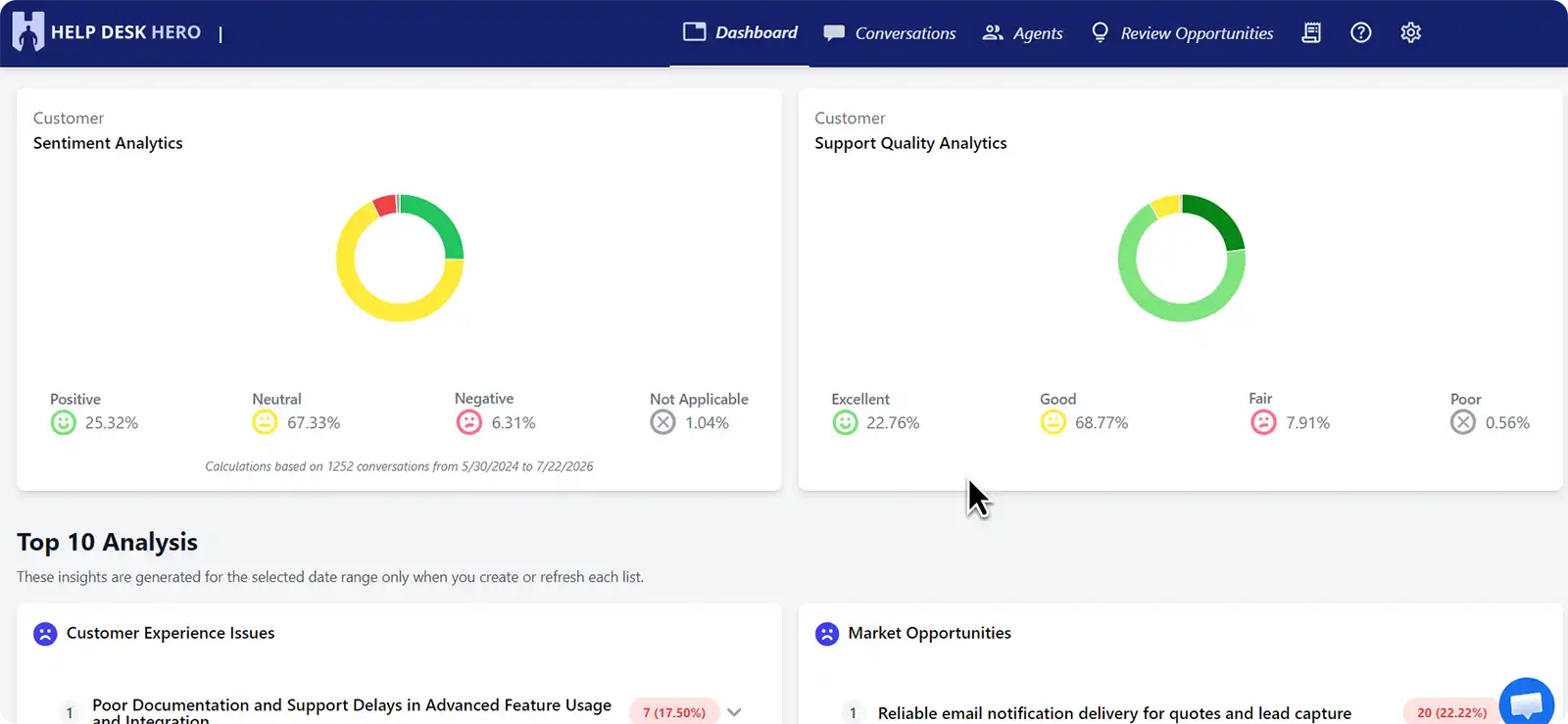
It syncs and analyzes support conversations so teams do not have to read every chat one by one. Instead, they can focus on the patterns that need attention.
Help Desk Hero can surface:
- Repeated customer questions
- Customer sentiment and feedback
- Common pain points
- Feature requests
- Possible bugs and recurring issues
- Sales and upselling opportunities
Its FAQ workflow can turn real customer questions into reusable content for a Crisp knowledge base.
Where Help Desk Hero Fits in the Loop
Help Desk Hero supports the clustering and conversion stages of the Conversation-to-Knowledge Loop.
It finds patterns across conversations and turns them into drafts and insights that people can review, approve, and act on.
This reduces the time spent searching through individual chats. It also makes it easier to share customer knowledge across support, product, marketing, and sales.
Human review still matters. Help Desk Hero does not replace product knowledge, policy ownership, privacy controls, or final approval. It makes the review process easier by showing teams where to look.
You can explore the current Help Desk Hero conversation analytics features or read the Help Desk Hero June 2026 product update to see the latest workflow improvements.
This is the useful promise of Crisp customer support analytics. It should not only report what happened in the inbox. It should help us decide what to document, fix, share, and measure next.
The Real Opportunity Is to Make Every Answer Reusable
This survey does not prove that every repeated question can be removed.
Some customers need a human conversation. Some answers depend on a specific account, order, product setup, or situation.
But the survey does show a clear pattern in this Help Desk Hero onboarding sample.
Of 148 support-challenge responses, 65.5% selected either too many repetitive questions or outdated or missing FAQs.
Another 29.1% selected a lack of insights from customer feedback.
The common thread is knowledge that has not yet become reusable.
When the answer stays inside one chat, we pay for it again in the next conversation.
When we capture the pattern, verify the answer, and share it, the same conversation can improve:
- Support speed and consistency
- Help-center content
- Product decisions
- Customer onboarding
- Marketing messages
- Sales responses
- AI and chatbot knowledge
That is how we begin to close the Crisp Support Knowledge Gap.
We do not only answer faster. We learn from the conversation, improve the source of confusion, and make the approved answer easier to find next time.
FAQs
What is Crisp analytics?
Crisp analytics is the process of measuring and studying activity in Crisp conversations. It can include volume, response patterns, sentiment, repeated questions, feedback, feature requests, bugs, and sales opportunities.
What is the Crisp Support Knowledge Gap?
It is the space between what customers keep asking in Crisp Live Chat and what a company’s approved, reusable support knowledge can answer today.
Why do customers keep asking the same support questions?
The answer may be missing, old, hard to find, or unclear. The source of confusion may also be in the product, onboarding, pricing, policy, or marketing copy.
How can we find repetitive questions in Crisp Live Chat?
Review a useful set of conversations, group questions by meaning, count how often each group appears, and rank them by frequency and customer impact. Crisp live chat analytics tools can reduce the manual review.
How do we turn Crisp conversations into FAQs?
Find repeated questions, collect the current answers, resolve conflicts, draft one clear answer, remove private details, verify it with the right owner, and publish it where customers and agents can find it.
What is an automatic FAQ generator for Crisp?
It is a tool that analyzes Crisp chats to find repeated questions and create FAQ drafts. A person should review the drafts for facts, privacy, policy, tone, and current product details before publishing.
Can AI analyze Crisp conversations?
Yes. AI can classify chats, group similar questions, summarize themes, detect sentiment, and surface possible requests, bugs, objections, and FAQs. People should review the output before taking high-impact action.
What is an AI help desk for Crisp?
An AI help desk for Crisp uses AI to support tasks such as conversation analysis, FAQ drafting, answer retrieval, agent help, or chatbot replies. Its quality depends on the source data and approval process.
Can Crisp conversations reveal feature requests and bugs?
Yes. Customers often describe missing features, failed tasks, and recurring errors in chat. Teams should group similar reports and confirm each pattern before it becomes a product priority.
How often should support teams update their FAQs?
A monthly review is a useful starting point. Teams should also update an FAQ whenever a related product, price, policy, or workflow changes. Fast-moving products may need more frequent checks.
Should we train an AI chatbot on support conversations?
Do not treat raw conversations as approved knowledge. First remove unnecessary personal data, resolve mixed answers, verify current facts, and build a trusted knowledge layer for the chatbot.
What should we review before using chats to train a chatbot?
Review accuracy, age, privacy, confidential data, consent and data-use rules, access, retention, product scope, legal duties, tone, and company policy. Give the chatbot only the information it is allowed to use.
What is the best Crisp plugin for conversation analytics?
The best Crisp plugin depends on the job. Check whether it can connect to Crisp, analyze patterns across chats, extract FAQs, surface feedback, support human review, protect customer data, and produce useful next actions. Help Desk Hero is built for this conversation-to-knowledge workflow.
How can support chats improve product and marketing decisions?
Grouped chats can reveal common requests, bugs, confusing steps, pricing concerns, customer language, and weak website messages. Validate the pattern, then send each insight to a named owner who can act on it.

Hey, I’m Mike Belanger, a business enthusiast with over 15 years of experience in designing, web and app development, business management, digital marketing, customer psychology and optimizing businesses. I love making businesses grow and operate smoother.